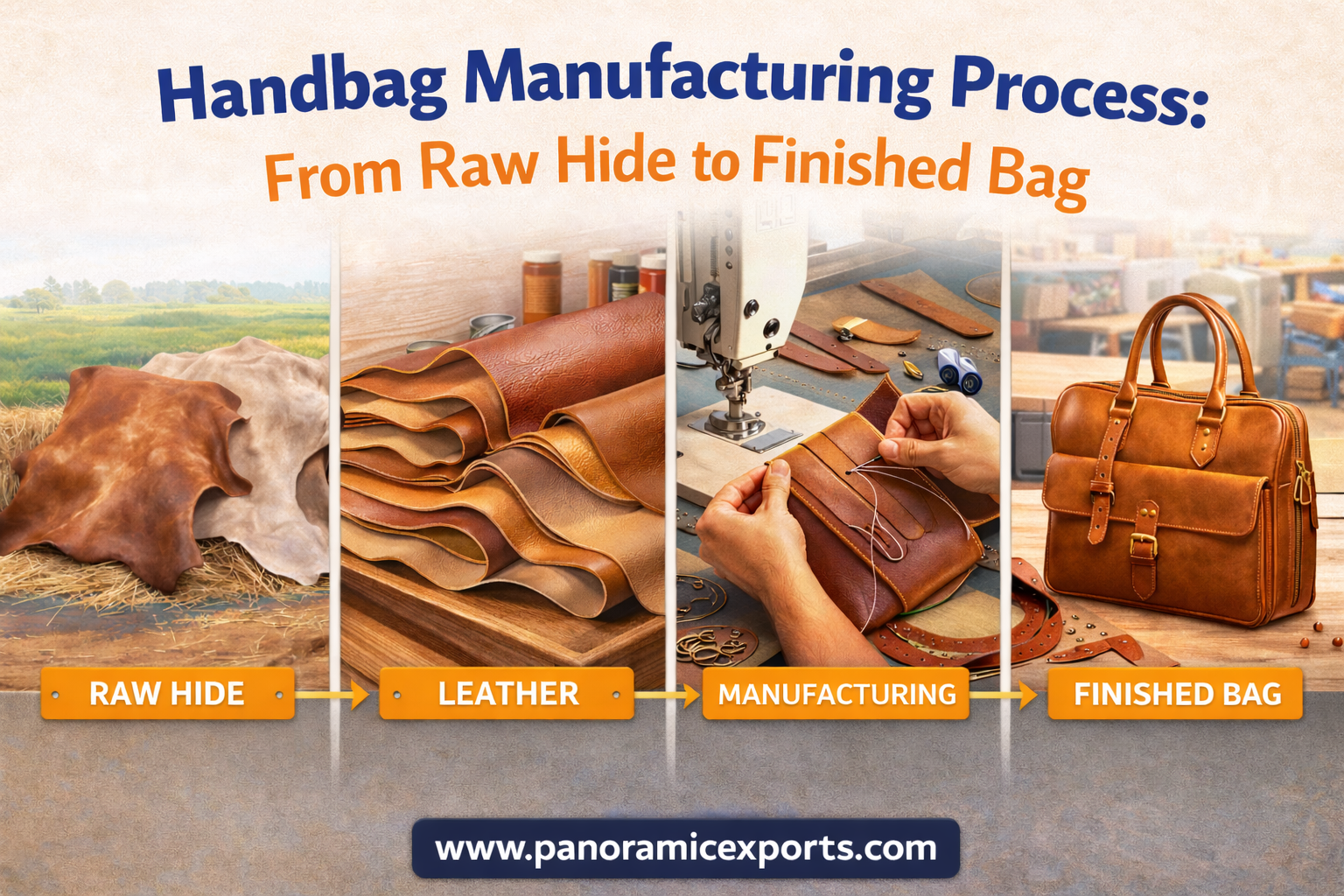
Handbag Manufacturing Process: From Raw Hide to Finished Bag
The process of an export-quality leather bag is a complicated process that involves classical craftsmanship, as well as modern industrial accuracy. To the global customer, it is important to know the Handbag Manufacturing Process in terms of quality, sustainability and durability. By 2026, the requirements of transparency imply that each step, starting with the first tan of the hide and ending with a final stitch, has to be international standards. The Indian leather export sector operates under structured industry oversight from bodies such as the Council for Leather Exports (CLE).
A good leather bag production process will make the end product not just a fashion accessory; but a masterpiece work of an engineering production process. The following is the step-by-step analysis of the handbag manufacturing process of turning a raw hide into a retail luxury product.
Step 1: Material Sourcing and Tanning
The Handbag Manufacturing Process starts way before the manufacturing floor. It starts at the tannery. The treatment done on raw hides is either Chrome Tanning (soft, colored leather) or Vegetable Tanning (barks of the trees that are used in providing a stiff and eco-friendly finish).
Grading
Hides are examined on the basis of yield. Bags of high-end need to be made out of A-Grade leather, which is not much damaged by deep scars or bites.
Splitting & Sharing
The leather is cut to a uniform thickness (1.2mm to 2.0mm) so that the bag is not too heavy or too thin.
Step 2: Prototype Development and Pattern Making
A Master Pattern is made before mass production. It is a critical step in the production of leather bags because the 2D design is converted into the 3D reality.
CAD Design
The digital patterns provide mathematical accuracy of laser cutting.
Counter Sample
A hard sample is made to test the hang of the bag, internal volume and the strength of the bag.
Step 3: Precision Cutting
After the pattern is accepted the leather is cut. There are two primary processes in the professional Handbag Manufacturing Process:
Die Cutting
High-volume accuracy is achieved by high volume and heavy steel knives plus a hydraulic press.
Laser/Digital Cutting
This is the best to use when the design results are very complex or when the order is a one-off but the volumes are low since there is no way of making a mistake.
Step 4: Preparation and Skiving
Leather is naturally thick. In order to have clean and folded edges without build the edges of the cut panels are skived. The underside of the leather edge is shaved by a special machine to leave it paper thin to enable it to be folded over before being sewn on.
Step 5: Assembly and Stitching
This is where the Handbag Manufacturing Process begins. The panels are joined with heavy-duty industrial sewing machines by skilled artisans.
Reinforcement
Handle attachments, corners of the base are reinforced with tapes of non-stretch (or bonded nylon).
Lining
Linings are sewn in together and may include a drop-in type of construction to have a luxury feel.
Step 6: Edge Finishing and Hardware
The distinction between a good bag and a luxury bag is in the fringe.
Edge Painting
This is a procedure that involves a number of coats of specialized Italian paint that has been sanded to produce a smooth rubberized medium.
Fitting of Hardware
Heavy brass or zinc-alloy zippers, buckles and feet are hand-fitted so that they will not scratch the leather in the process of assembly.
Advanced Techniques in the Modern Handbag Manufacturing Process
The way quality is being redefined as we look at the future of leather bag production process in 2026 is by incorporation of technology and sustainability. In addition to the usual cutting and stitching, there are newer sophisticated methods that are necessary to all brands that wish to compete at the high export market.
1. Structural Reinforcement and Boning
The Handbag Manufacturing Process currently includes internal reinforcements in order to keep the shape of an expensive bag over the decades of usage. That incorporates the application of salpa (re-created leather) or special synthetic stabilizers between the leather and the lining. These make the leather not to drop down and have a light bag. This is also referred to as building the skeleton of the bag in circles of professional leather bag production processes.
2. Sustainable Adhesive Technology
The environmental standards have no longer been limited to the leather. The current process protocols used in the handbag manufacturing process have adopted water-based and environment-friendly glues instead of the use of the solvent-based glues. These glues are less harmful to the workers at the factory and the product made can be used free of the body smelling chemicals that most of the cheap imports are known to have.
3. Precision Heat Creasing
Heat creasing is one of the characteristics of a really luxurious process of leather bags production. This can be done by pressing a fine decorative line along the edges of the leather, towards the stitching with the use of a metal tool that may be hot or cold. This is not merely the visual pop, it actually tightens the fibers of the leather, which make its edges more resistant and less prone to fraying.
Global Logistics: The Final Stage of Production
The Handbag Manufacturing Process does not really conclude until the product is packed up safely. Stuffing is a very important sub-step as far as international export is concerned. To preserve the shape of the bag, one should use acid-free tissue paper or air-filled pillows so that the bag can withstand the 30 days trip by sea between India and the USA or Europe. Moreover, anti-mold stickers (Micro-Pak) have become an obligatory condition of the process of leather bag production to resist the humidity changes during the transit.
With such granular details, buyers can be able to gauge more well the true value of their inventory. These invisible steps will never be missed at Panoramic Exports and your investment is not wasted at the factory to the retail shelf.
Panoramic Exports: Mastering the Production Lifecycle
The Handbag Manufacturing Process in India would not be easy without an on-ground partner that would be aware of the technicalities of every stage. Panoramic Exports is your technical ears and eyes so that your production run do not go off course.
We will contribute value to your process of producing leather bags by:
1. Tannery Audits
We get our supply of tannery material at LWG certified tanneries at Kanpur and Chennai so that the raw material is already compliant with the requirements of the REACH.
2. Technical Supervision: On-site
Our team has supervision of the work on the “skiving” and the “stitching” stages to avoid the usual problems related to the process such as the puckering problem and the problem of erratic seams.
3. Timeline Management
We remove the delays that are characteristic of offshore manufacturing by tracking every step, i.e. cutting, to the final packing.
Conclusion
The Handbag Manufacturing Process is a labor of love that requires a symphony of different skills. From the chemical science of tanning to the manual dexterity of edge painting, every step in the leather bag production process must be executed with the end consumer in mind. For global brands, partnering with a expert like Panoramic Exports ensures that this complex journey results in a product that is beautiful, durable and ethically produced.
FAQs
1. How long does the typical Handbag Manufacturing Process take?
A standard production cycle for an export order is 60 to 90 days, including material sourcing.
2. Why is “skiving” so important in leather bag production?
Without skiving, the seams where multiple layers of leather meet would be too thick to sew and would look bulky and unprofessional.
3. Can a leather bag production process be fully automated?
While cutting can be automated, high-quality stitching and edge finishing still require the skilled hands of an artisan.
4. What is the most common cause of failure in the handbag manufacturing process?
Most failures occur during the “material preparation” stage, where incorrect leather thickness leads to structural weakness.
5. How does Panoramic Exports ensure the lining doesn’t tear?
We specify high-denier fabrics and ensure all internal seams are double-stitched and “taped” for maximum durability.