
Mar 13, 2026
How to Make Beaded Handbags?
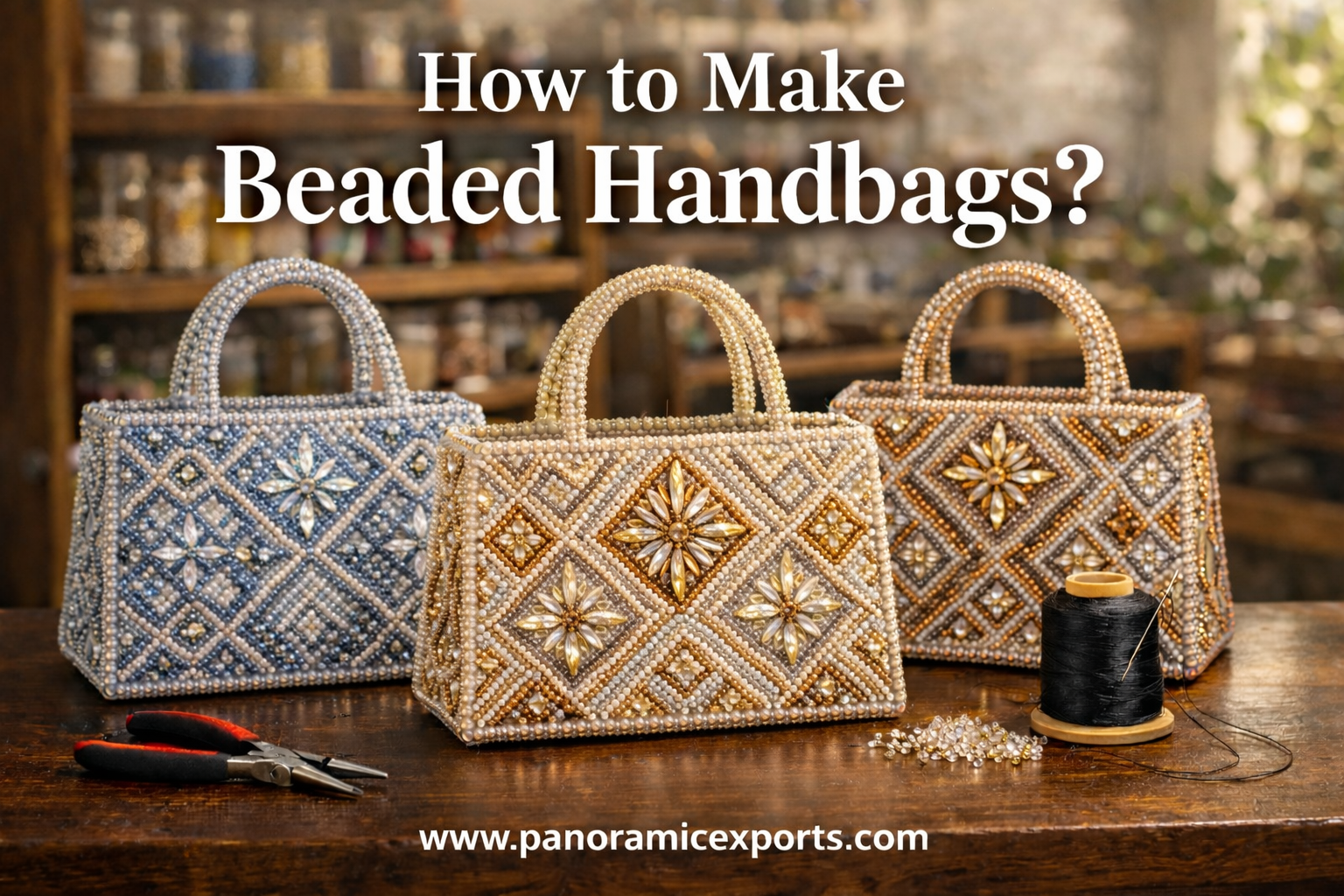
How to Make Beaded Handbags?
Look, most people think making Beaded Handbags is just a relaxing afternoon of stringing glass on a line. If that’s your plan, you aren’t making a product; you’re making a mess. In the world of high-end export, a beaded bag isn’t jewelry—it’s a load-bearing structure. You’ve got thousands of glass beads trying to pull themselves to the floor and if your engineering is weak, the bag will look like a sad, saggy sack before it even hits the retail shelf.
At Panoramic Exports, we treat Beaded Handbags like a construction project. It’s about managing gravity and friction. If you want to build something that actually survives a night out or a global shipping container, you have to stop thinking about “pretty” and start thinking about “structural integrity”.
The Math Before the Needle
Before anyone picks up a bead, we’re doing math. Beaded Handbags are deceptively heavy. A standard-sized clutch can easily weigh as much as a small laptop. The material density and durability of the beads themselves also matter, especially when understanding the glass bead manufacturing process that influences overall bag strength. If you just start weaving without a plan, the weight will stretch your thread and by day three, the bag will be two inches longer than you intended.
We map out the weight distribution on a technical grid. We don’t use standard fishing line because it’s rubbish—it stretches and eventually snaps under UV light. We use a bonded nylon thread or a polymer-coated steel wire. You need something that has zero “creep.” If you want your Beaded Handbags to keep their shape, the foundation has to be as stiff as a bridge cable.
The Lattice: More Than Just a Pattern
When we weave a bag at Panoramic Exports, we aren’t just sewing. We are building a lattice. This is the “skin” of the bag and it’s under constant tension. The secret to a bag that feels “solid” rather than “mushy” is the double-pass. Every single bead has the thread running through it at least twice, often three times in the corners.
This creates a redundant system. If a customer snags a bead on a car door and one thread snaps, the bag stays together. Most cheap Beaded Handbags use a single-pass method. One break and the whole thing unspools like a nightmare. We also hide “anchor knots” every few inches. It’s a pain to do and it slows down production, but it’s the only way to guarantee the bag won’t fall apart.
The Bone Structure: Frames and Mesh
If you put a bag on a table and it collapses into a puddle of beads, you failed. To get that high-end, sculptural look, you need a skeleton. For professional Beaded Handbags, that usually means a hidden acrylic box or a reinforced wire mesh frame.
This skeleton takes the weight so the beads don’t have to. It gives the bag that satisfying “clink” when you set it down. It’s the difference between a cheap souvenir and a luxury accessory. Without a frame, the gussets (the sides) will always buckle inward. You can’t fix that with more Beads; you fix it with better bones.
The Lining: Don’t Glue It
This is where the amateurs give themselves away. They build a beautiful Bead exterior and then try to glue a lining inside. It never works. Within a week, the glue fails and the lining is a tangled mess.
For professional Beaded Handbags, the lining has to “float.” We hand-stitch the interior fabric to the frame, not the beads. This way, when the customer drops their heavy keys or a phone into the bag, the weight pulls on the internal frame, not the delicate beadwork. It’s a “bag within a bag” philosophy. At Panoramic Exports, we use high-denier satin that can handle the friction of the beads without fraying.
Hardware: Anchors, Not Just Zippers
The handles and clasps are the highest stress points on any bag. If you just sew a handle onto the top layer of beads, it will rip off. Period. For our Beaded Handbags, we use “D-ring” anchors that are woven directly into the structural wire. The handle becomes part of the bag’s DNA.
We also run “stress tests” in the workshop. We hang the bags with double the intended weight for 24 hours. If there’s even a millimeter of stretch, the design goes back to the drawing board. This is why Panoramic Exports is the go-to for brands that can’t afford quality complaints. We handle the grit so you get the glitter.
The Sustainability of Craft: Why Construction Matters
In 2026, you can’t talk about Beaded Handbags without talking about the lifespan of the product. The world is finally waking up to the fact that “cheap” is actually expensive when the item ends up in a landfill after three uses. When we build a bag at Panoramic Exports, we’re thinking about the ten-year mark, not just the ten-minute mark on a retail shelf.
A bag built with a floating lining and a reinforced skeleton is, by definition, a sustainable choice. Why? Because it doesn’t break. If a thread is bonded nylon and the beads are high-grade glass, the bag doesn’t degrade. It becomes a vintage piece rather than trash. We see a lot of “greenwashing” in the industry, but true sustainability starts with a needle that doesn’t fail and a frame that doesn’t snap.
This level of detail is also what protects the artisans. Hand-weaving a structural lattice is an elite skill. By refusing to cut corners with single-pass sewing or cheap glue, we ensure that the craft remains a respected profession. At Panoramic Exports, we aren’t just selling a bag; we’re selling the hours of focus and the technical mastery it took to keep those beads in perfect, rigid alignment. If you want a brand that stands for more than just aesthetics, you have to invest in the engineering.
Conclusion
Building Beaded Handbags is a brutal, hand-cramping process. It’s slow, it’s expensive and there are no shortcuts. But when you hold a bag that’s been built with proper tension and a solid skeleton, you feel the difference immediately. It feels like an object of value, not a fragile toy.
At Panoramic Exports, we aren’t interested in making “fast fashion” junk. We make pieces that are intended to be kept. If you want to know how to make a bag that actually lasts, you start with the structure and end with the sparkle.
FAQs
1. Why does my beaded bag look “warped”?
It’s a tension issue. You’re likely pulling too hard in some spots and not enough in others. You need a consistent “drag” on the thread.
2. Can I use regular thread for Beaded Handbags?
No. Cotton will rot and polyester will stretch. Use bonded nylon or coated steel wire if you want it to survive a season.
3. How do I stop the bottom from sagging?
You need an internal base plate—usually acrylic or a heavy-duty mesh. Beads cannot support their own weight over a wide area.
4. Is hand-weaving better than machine-made?
For intricate 3D shapes, machines can’t touch the precision of a human hand. Machines are for “flat” work; artisans are for “structure.”
5. How do you clean these Beaded Handbags?
Gently. Use a soft damp cloth. Never soak them—the internal wire might be rust-resistant, but you don’t want to test the lining’s limits.