
Mar 18, 2026
Export Packaging Standards for Leather Goods
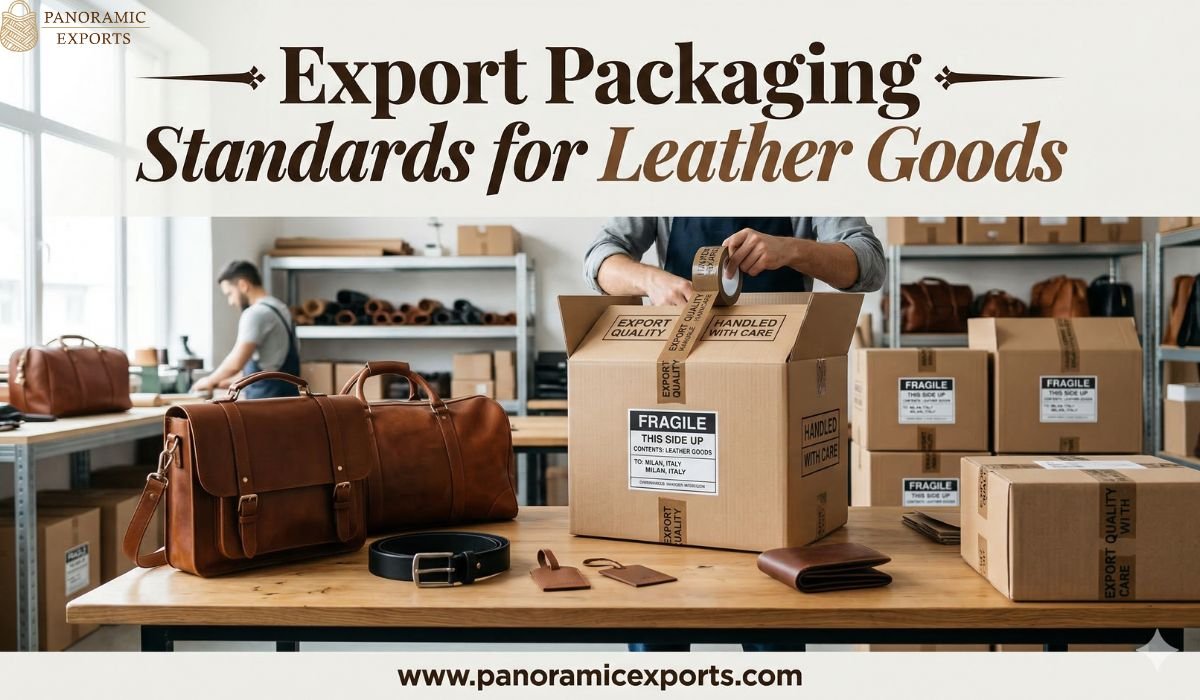
Export Packaging Standards for Leather Goods
In global manufacturing, your product is only as good as the state it’s in when the container seal breaks. For an Export Ready Leather Packaging strategy, “decent” is just a disaster waiting to happen. Between Aspergillus mold and the August 2026 EU PPWR regulations, your packing list is now as critical as your stitching; you aren’t just selling leather, you’re selling the security of the journey.
At Panoramic Exports, we’ve seen $100,000 shipments turn into biohazards due to cheap, acidic tissue or the wrong silica grade. As we hit mid-2026, global markets demand traceable, plastic-free and chemically compliant solutions that survive a 45-day sea voyage and a strict customs audit. This is why export ready packaging has shifted from a warehouse afterthought to a boardroom priority.
2026 Mandates: Recyclability and Chemical Limits
Every piece of your packing—from the hangtag string to the master carton—must be designed for recycling under the new 2026 mandates. Mixed-material packaging, like those glossy plastic-coated paper boxes, is being phased out in favor of mono-materials that a machine can actually sort. If your Export Ready Leather Packaging uses plastic laminates on paper, expect a “Red” recyclability rating and a massive hike in your EPR (Extended Producer Responsibility) fees. The goal is a circular economy where the box is just as valuable as the scrap leather inside the factory.
Articles 5 and 6 of the PPWR now enforce a strict 100 mg/kg limit for the sum of lead, cadmium, mercury and hexavalent chromium in packaging. This means your printing inks and the adhesives in your corrugated boxes are now under the same microscopic scrutiny as the leather itself. We test our boxes because we know a single “hot” batch of ink can get an entire container seized at the port. We’ve also moved to high-strength, single-wall reinforced corrugated board to reduce weight and carbon taxes without sacrificing protection. This shift in Export Ready Leather Packaging is what keeps your margins healthy in an era of rising logistics costs.
ISPM 15 Wood Standards and Structural Integrity
Biosecurity rejections are a lead-time killer. For any export ready leather packaging setup using wooden pallets, crates or dunnage, ISPM-15 remains the globally accepted standard for wood packaging treatment in international trade (as explained by USDA APHIS).; if your wood isn’t treated, your shipment is dead on arrival. In 2026, Heat Treatment (HT) is the only “future-proof” choice for the EU and Australia, as it leaves zero toxic residue on your leather. At Panoramic Exports, we recommend manufactured wood (plywood) for smaller crates, which are ISPM 15 exempt and significantly lower your air-freight weight.
A snapped pallet is a product killer. We utilize reinforced, heat-treated Euro pallets to survive the rough “last mile” in global warehouses. By calculating precise load-bearing limits, we ensure that even in a five-high stack, your export ready leather packaging provides a structural foundation that keeps bottom-layer goods in showroom condition.
Moisture Management: The “Wet-Blue” Defense
Leather is organic and needs to breathe. In a sea container crossing the equator, this “breathing” leads to “Container Rain” and fiber fatigue. Without a technical moisture plan, the humidity of the Suez Canal can turn a premium shipment into a total insurance claim. At Panoramic Exports, we avoid the “greenhouse effect” of airtight plastic by using breathable, non-woven dust bags and acid-free tissue. This Export Ready Leather Packaging philosophy protects the grain from scuffs while allowing the hide to acclimate safely to temperature shifts.
We don’t just toss in random silica; we use high-absorption, DMF-free gel that meets strict EU safety standards. Unlike cheap vendors using toxic Dimethyl Fumarate, our data-driven export ready leather packaging includes humidity indicator cards so you can see the exact “weather” your goods endured. This prevents the “blooming” of fats and oils on the surface, ensuring your bags arrive in showroom condition despite the relentless moisture of the Bay of Bengal.
The “Invisible” Details: pH Migration and Tarnish
A bag is only as good as its hardware. In Export Ready Leather Packaging, acidic paper often reacts with tanning chemicals during a 30-day voyage, causing permanent staining. At Panoramic Exports, we use strictly pH-neutral tissue to ensure white leather stays white and prevent “color migration” in vibrating containers.
Metal buckles are magnets for salt-air corrosion. We wrap all hardware in specialized VCI paper to create a protective layer against oxidation without leaving oily residues. It is a small detail in leather packaging, but it keeps a luxury bag from arriving looking like it sat in a damp basement.
Why Panoramic Exports is Your On-Ground Muscle
We don’t just manufacture leather; we engineer the journey. Our Export Ready Leather Packaging protocols are built on 25 years of trial, error and hard-won success. We understand that your brand’s reputation is inside that box. From ensuring your shipping marks are REACH compliant to verifying the moisture content of the master cartons themselves (which shouldn’t exceed 12%), we handle the “gritty” details. We are the extension of your team on the factory floor in India.
The Future of Logistics: Carbon Neutrality
By the end of 2026, the focus will shift even further toward the carbon footprint of the box itself. We are already experimenting with mycelium-based buffers and algae-based inks to stay ahead of the curve. Choosing the right export ready leather packaging today means you are future-proofing your brand for the regulations of tomorrow. We believe that sustainability isn’t a cost; it’s an investment in the longevity of the leather craft.
Conclusion
The gap between a “good” manufacturer and a “great” exporter is the attention paid to the box. When you invest in Export Ready Leather Packaging with Panoramic Exports, you are buying 25 years of heritage and a commitment to excellence. We ensure that the soul we put into the leather isn’t ruined by 30 days of bad weather. As we move into the second half of 2026, the companies that survive will be the ones that master the “Packaging-as-Data” and “Packaging-as-Sustainability” shift. Let’s get your next shipment ready for the world stage. Our export ready leather packaging isn’t just about protection; it’s about a professional arrival.
FAQs
1. Does ISPM 15 apply to plywood boxes in 2026?
No. Plywood and other “processed” woods remain exempt because the heat and pressure used in their manufacturing process kill any potential pests naturally.
2. How do I meet the new EU PPWR labeling requirements?
By August 12, 2026, you must feature specific pictograms on your Export Ready Leather Packaging that indicate material composition (e.g., PAP 20 for corrugated fiberboard).
3. What is “Container Rain” and how do I stop it?
It’s condensation that forms on the ceiling of a container due to temperature shifts. We stop it by using industrial desiccant poles and ensuring master cartons aren’t damp when loaded.
4. Is plastic bubble wrap banned for exports in 2026?
It’s not banned, but it’s heavily taxed in the UK and EU under plastic waste levies. We recommend switching to “honeycomb” paper wrap for a more “compliance-friendly” alternative.
5. Why is DMF-free silica gel so important?
Dimethyl Fumarate (DMF) is a powerful anti-molding agent but is highly toxic and banned in the EU. Using it in your export ready packaging can lead to total shipment seizures and legal fines.