
Mar 16, 2026
How to Make Beaded Bag Charms?
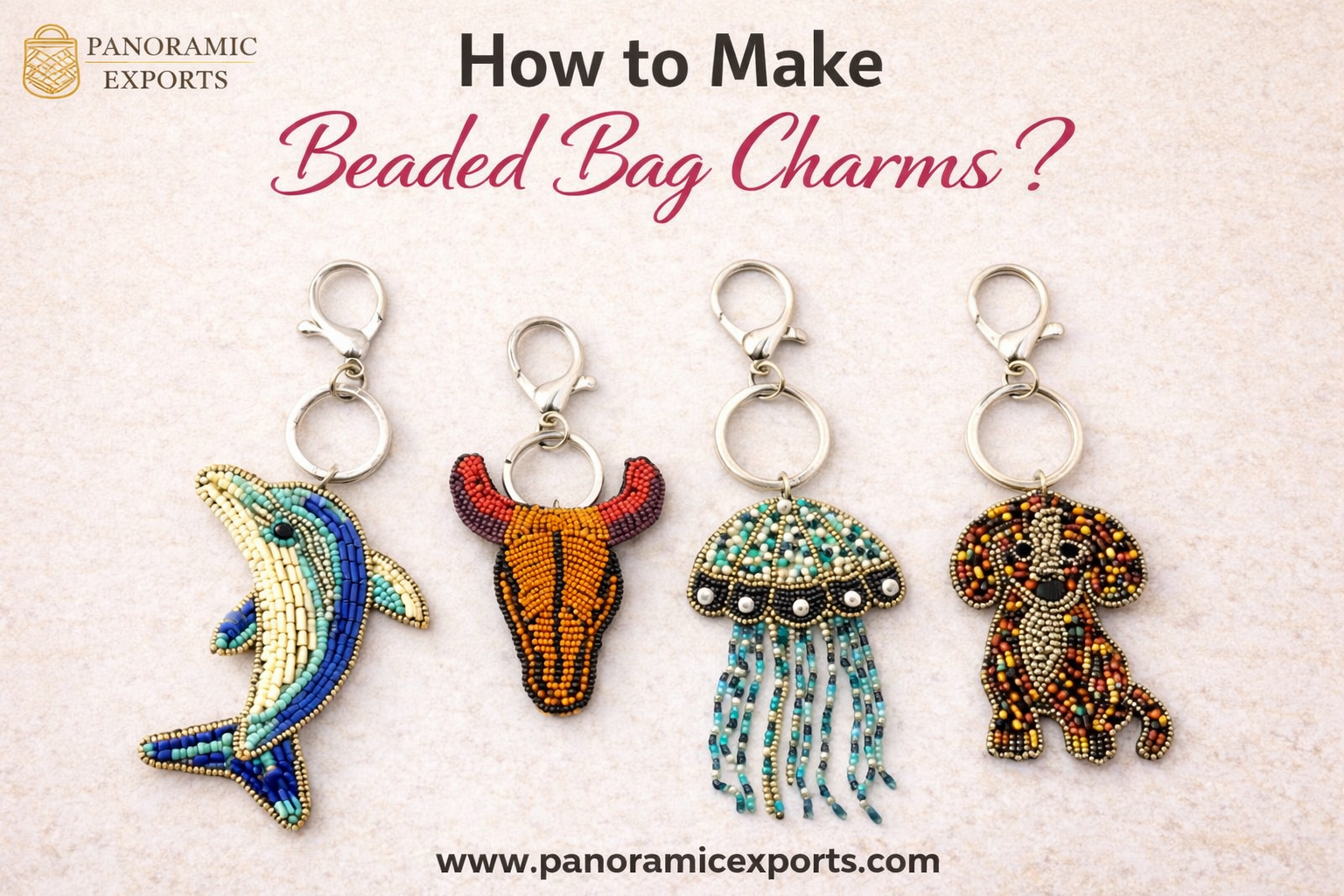
How to Make Beaded Bag Charms?
In the high-stakes world of global fashion exports, a “trinket” is a liability. For a retail buyer in New York or Berlin, Beaded Bag Charms aren’t just accessories—they’re high-margin add-ons that have to survive rough handling, humidity and the legal minefield of international safety laws. If you want to know how to make these at a professional level, you have to look past the “craft” and focus on the engineering.
At Panoramic Exports, we don’t do “hobby projects”. We do industrial-grade accessory manufacturing. Moving Beaded Bag Charms from an Indian workshop to a global storefront means solving the physics of the stringing material and the chemistry of the hardware plating. Here is the professional breakdown of how we build value into the “small stuff”.
Step 1: The Foundation and Material Selection
The most common failure point in beaded bag charms is the core string. If you want to know how to make a product that lasts, you start by throwing away the elastic. Hobbyist suppliers often use cheap monofilament that degrades under UV light and snaps under the slightest pressure.
For professional global export, we use 49-strand stainless steel wire with a heavy nylon coating. It has the “drape” of silk but the break-strength of an industrial cable. In our workshop, we perform random “Pull Tests”. Every Beaded Bag Charms batch must withstand a 10lb pull without the crimps failing. This isn’t just a quality check; it’s an insurance policy against the “Choking Hazard” recalls that keep US and EU compliance officers awake at night. Exporters often reference accessory durability and small-parts safety guidance issued by the U.S. Consumer Product Safety Commission.
Step 2: Professional Layout and Design Mix
A cute bag charms design only works if it feels like a discovery, not a commodity. Plastic-heavy charms feel like toys. A multi-textured piece feels like jewelry. We leverage India’s massive artisanal network to find components that machines can’t replicate.
When planning how to make the charm, we mix high-shine metallic spacers with “matte” finished Indian hardwoods and handmade glass. This “maximalist” approach to Beaded Bag charms is why our clients can command a premium price. We don’t just “find beads”; we curate a material story that makes a handbag charm feel like a bespoke find, not an afterthought.
Step 3: The Assembly and Tensioning Process
How you actually string the beads determines the “drape” of the final product. If the wire is too tight, the charm is stiff and looks cheap. If it’s too loose, the wire shows.
-
Crimp Placement: We start by securing a high-grade copper crimp bead to the lobster clasp. We don’t just crush it; we use a “forming” tool that rounds the metal so it doesn’t snag the bag’s leather.
-
The Stringing Sequence: We alternate bead weights. Putting a heavy glass bead next to a light wooden one creates a “rhythm” in the swing.
-
The Double-Back: At the finish point, we thread the wire back through the last three beads. This “locking” mechanism is essential for Beaded Bag Charms that will be tugged on by customers daily.
Step 4: Chemical Compliance and Plating
If your custom bag charm shipment is seized at the border because the “gold” plating has high lead content, your whole season is dead. Many factories cut costs by using leaded alloys. We don’t.
Every single part of our beaded bag charms is 100% lead and nickel-free.
-
Vacuum Plating: We use PVD (Physical Vapor Deposition) for all hardware. Unlike the “dipped” charms you see in discount bins, this won’t tarnish or flake off on a customer’s $2,000 leather tote.
-
Non-Toxic Hues: Whether it’s artisan glass or carved Indian wood, we verify that all dyes are non-bleeding and REACH compliant. This matters for purse charms that might touch skin or moisture.
Step 5: Weight and Balance Engineering
Most people think you just string beads and call it a day. But a professional manufacturer looks at the “Center of Gravity”. If a charm is too bottom-heavy, it swings violently and can scratch the bag’s hardware.
We engineer the weight distribution so that the charm has a satisfying “clink” without becoming a wrecking ball. This involves calculating the density of each Bead—using heavier glass at the core and lighter wood or resin at the extremities. It’s this level of detail that separates a custom bag charm produced for a luxury brand from something bought at a flea market.
Step 6: Industrial Sealing and Finishing
In India’s humid climates, wooden beads can be a nightmare. At Panoramic Exports, we use a multi-step sealing process. Every wooden element in our Beaded Bag Charms is tumbled in a specialized sealant that prevents the wood from absorbing moisture and expanding.
Similarly, for any leather elements integrated into the handbag charm, we use the same high-end edge paint used in luxury handbags. This ensures that the color doesn’t rub off on the customer’s clothes or the bag itself. We’re not just making purse charms; we’re making durable goods.
Step 7: Packaging for Retail
A beaded bag charms order can be ruined in the last mile by bad packaging. We provide “Retail-Ready” solutions so you don’t have to touch the product at your distribution center.
-
Anti-Tangle Mounting: We mount every bag charm on a rigid 350gsm backer card. This prevents the “bead-nesting” that happens in sea containers.
-
Anti-Tarnish Environment: Every master carton includes charcoal-based desiccant strips. This keeps the hardware on your purse charms bright even after 30 days in a humid shipping container.
-
SKU Precision: We handle all barcoding and price-tagging in-house. When the shipment hits your dock, the custom bag charm is ready for the floor immediately.
Scaling Your Production with Panoramic Exports
The “India Advantage” isn’t just about labor—it’s about a specialized ecosystem. At Panoramic Exports, we sit at the intersection of traditional Indian beadwork and 2026 global QC standards.
Our Industrial Edge:
-
Prototyping Speed: We can take a mood board and turn it into a physical Beaded Bag Charms sample in 7 days.
-
Scalable Precision: We manage the MOQs that make sense for your brand, from a 500-unit boutique “drop” to a 20,000-unit national rollout.
-
Ethical Supply Chain: Every handbag charm is made in an audited, fair-wage environment. Transparency is our baseline.
Conclusion
In 2026, small accessories carry huge brand weight. Learning how to make professional Beaded Bag Charms is about realizing that every detail—from the wire to the packaging—is a chance to delight a customer. By focusing on durability engineering, chemical safety and retail-ready logistics, we make sure your custom bag charm is a profit driver, not a recall risk.
At Panoramic Exports, we protect your reputation on the retail floor.
FAQs
1. How do you handle color-fastness in these charms?
We use industrial-grade sealants on all wooden beads to ensure they don’t bleed onto expensive leather, a common fear for handbag charm buyers.
2. Are the springs in the clasps tested for fatigue?
Yes. Every batch of lobster clasps for our purse charms is cycle-tested. If the gate tension is mushy, we reject the lot.
3. Can you provide third-party lab reports?
Absolutely. We work with certified labs to provide lead and nickel-free documentation for all Beaded Bag Charms bound for the USA or Europe.
4. What is the maximum weight you recommend?
We engineer our designs to stay under 100 grams. Anything heavier can cause “handle sag” or put too much stress on a delicate bag’s stitching.
5. Can we get custom metal branding?
Yes, we can laser-etch or die-cast your logo onto a metal “signature” tag for every custom bag charm in your collection.