
Mar 19, 2026
Leather Bag Sample Development & Prototyping Guide
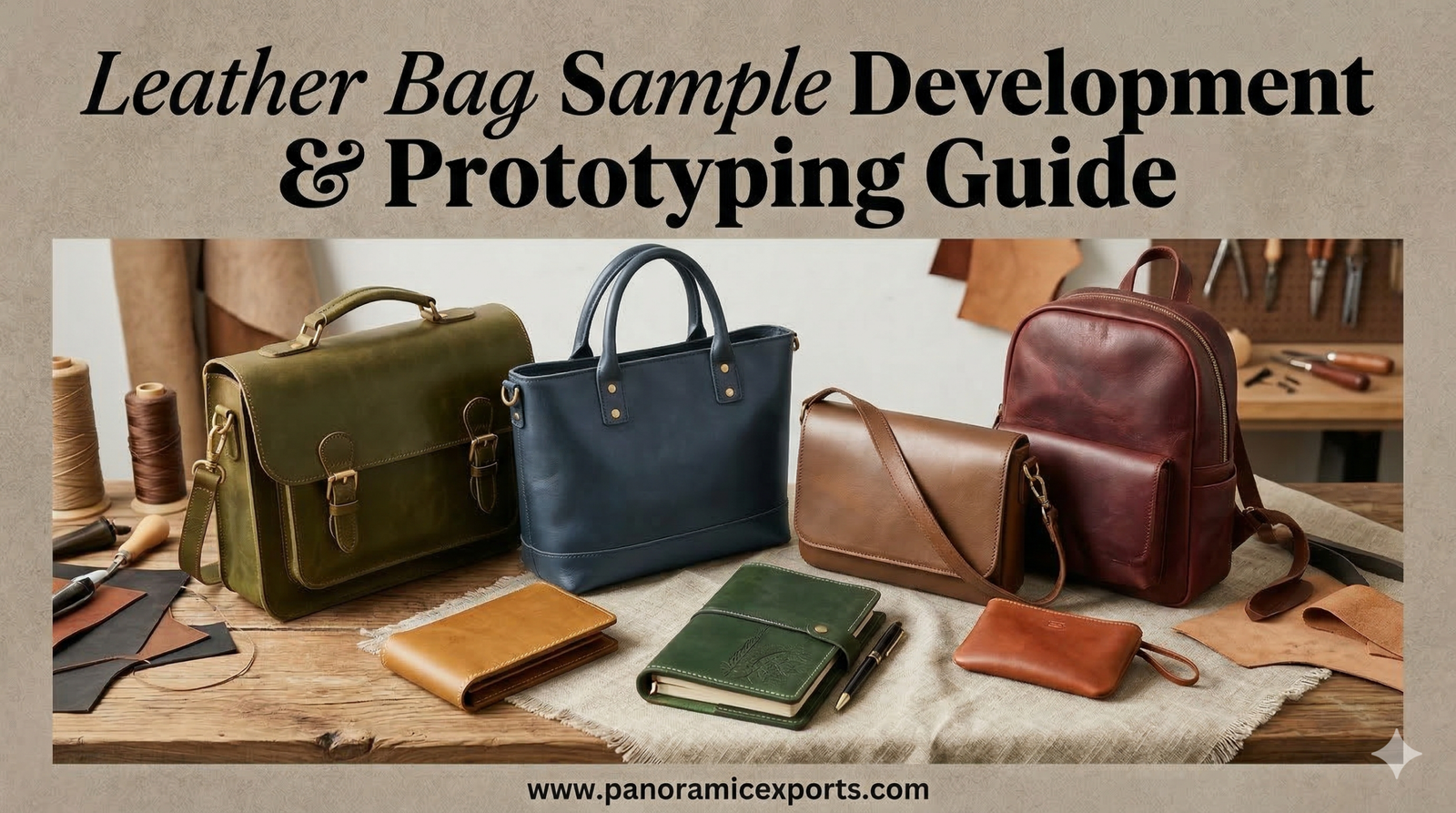
Leather Bag Sample Development & Prototyping Guide
There is a specific kind of silence in a sample room just before the first cut is made. It’s the moment where a designer’s vision—maybe it’s a rough sketch from a London studio or a detailed tech pack from New York—meets a physical hide of premium leather here in India. At Panoramic Exports, we know that Leather Bag Sample Development is the bridge between a dream and a retail success story. It is a process of trial, error and eventual perfection that ensures the bag doesn’t just look good in a photo, but performs perfectly in the hands of your customer.
If you get the sample wrong, you’re dead in the water. It doesn’t matter how good your marketing is. If the strap snaps or the leather “bleeds” on a customer’s white shirt, your brand is done. That’s why our prototyping unit isn’t just a room with some sewing machines. It’s a lab where we break things so they don’t break on your customers.
Phase 1: Leather Bag Sample Development – Material Deep-Dive
The very first step of Leather Bag Sample Development isn’t actually cutting; it’s feeling. We start by selecting the “skin.” Every leather has a different “temper”—some are stiff and snappy, others are buttery and slouchy. If you’re designing a structured tote, we might suggest a vegetable-tanned shoulder. If it’s a high-fashion crossbody, we might look at a drum-dyed nappa.
In this early stage, we talk about the “pull-up” effect, the grain consistency and how the leather will age. We aren’t just picking a color; we are picking the lifespan of the bag. This conversation is the foundation of the entire sample development cycle, ensuring the raw material matches the intended price point and retail “vibe” of your brand.
Phase 2: The Architecture of the Pattern
Once the leather is chosen, our master pattern makers move to their benches. This is the “structural engineering” of Leather Bag Sample Development. We translate 2D drawings into 3D paper models. We use heavy cardstock to build the bag’s skeleton, checking the drop of the handle, the depth of the gusset and the placement of the internal pockets.
This is where we calculate the “skiving.” Skiving is the art of thinning the edges of the leather so that when they are folded over for stitching, the seams remain sleek and elegant rather than bulky and amateur. A millimeter of difference here determines whether a bag looks like a luxury item or a budget knock-off. At Panoramic Exports, we obsess over these paper blueprints because they are the DNA of your future production run.
Phase 3: Sourcing the “Invisible” Quality
A leather bag is only as strong as its weakest component. During Leather Bag Sample Development, we spend an incredible amount of time on the “guts” of the bag. This includes the internal stays, the bonded nylon threads and the reinforcements like “salpa” that prevent the leather from stretching out of shape over time.
We also source the hardware—the jewelry of the bag. Whether it’s solid brass zippers, magnetic snaps with a specific “pull force,” or custom-branded rivets, we ensure every piece of metal matches the weight and finish of the leather. We also prioritize sustainability by working with LWG-certified tanneries, ensuring that the sample development process meets the high ethical standards of 2026 global markets.
Phase 4: The Moment of Truth (The Counter Sample)
The “Counter Sample” is the first time the bag exists in its final materials. It’s the most honest part of the Leather Bag Sample Development journey. This is where we “road test” the design.
We put the bag on a shoulder to see how it hangs. We fill it with a laptop and a wallet to see where the stress points are. Does the zipper glide smoothly around the curves? Does the lining rustle or does it feel premium? This is the stage for “micro-adjustments”—moving a strap attachment or adding a reinforced base. It’s about the tactile experience of the product.
Why Prototyping at Panoramic Exports is a Specialized Craft
At Panoramic Exports, our sampling unit is a dedicated space, away from the hum of mass production. It is staffed by artisans who have spent decades learning the “memory” of different hides.
-
Technical Problem Solving: We don’t just follow a sketch blindly. If we see a design flaw—like a handle that will eventually tear the leather—we’ll flag it during Leather Bag Sample Development and suggest a structural fix.
-
Rapid Response Prototyping: We know that fashion seasons don’t wait. We aim to move from a final concept to a physicalbag sample development prototype within 12 to 18 working days.
-
The Golden Sample: Once you approve the final version, we create the “Golden Sample.” This becomes the immutable standard for your bulk order. If the final production doesn’t match this sample exactly, it doesn’t leave our doors.
Precision in the Finishing Touches
In high-end Leather Bag Sample Development, the edges tell the whole story. We don’t believe in raw, unfinished edges. We use a multi-stage “edge painting” process, where each layer is hand-applied, dried and sanded back before the next coat goes on. This results in a smooth, lacquer-like finish that won’t crack or peel, even with years of use. It’s a slow process, but it’s what gives our bags their signature “Bond Street” look.
Conclusion
At the end of the day, Leather Bag Sample Development is an investment in your brand’s longevity. It is the phase where you find the small errors before they become expensive mistakes in a bulk order. Whether you are an established global retailer or a growing boutique label, the care and precision put into this development phase will define your quality in the eyes of your customers.
At Panoramic Exports, we take pride in being the hands that bring your vision to life. We don’t just build bags; we build the prototypes that give you the confidence to lead your market.
FAQs
1. How long does Leather Bag Sample Development take?
Generally, it takes between 12 and 18 days, depending on how custom your hardware and leather requirements are.
2. Can you build a prototype from a photo?
Yes, our pattern makers are experts at “reversing” a design from photos and dimensions into a full technical sample.
3. What exactly is a “Golden Sample”?
It’s the final, approved version of the bag that serves as the quality benchmark for every single unit in your bulk production.
4. Is there a separate fee for leather bag sample development?
Yes, as it involves specialized artisanal labor, though we often credit these costs back once a bulk order is placed.
5. Can I customize my zippers and rivets?
Absolutely. During the sample development phase, we can source or even create custom-branded hardware to fit your brand identity.